Flickering Lights, Warm Outlets and a Breaker That Keeps Tripping
These warning signs start small, and the hard part is that you cannot tell the minor ones from the serious ones by looking.
October 1, 2026 · 4 min read
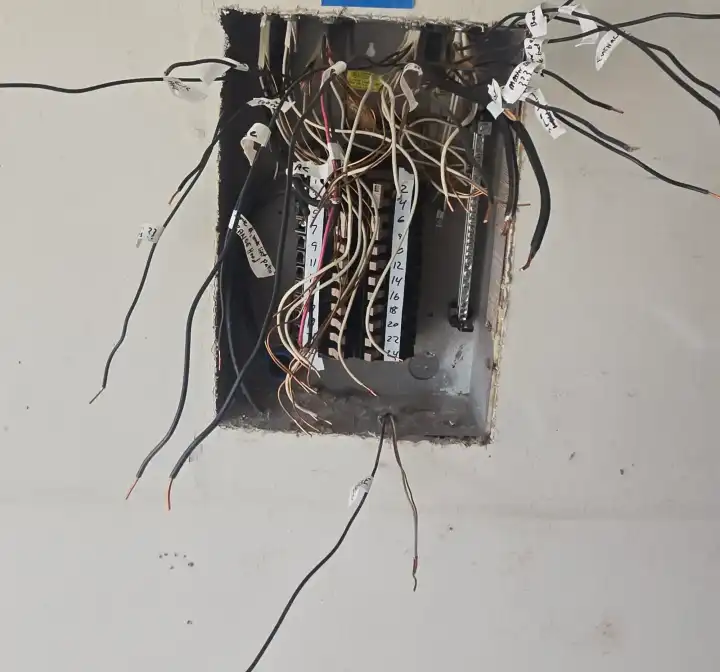
Electrical problems rarely start loud. They start as a light that dims when the dishwasher kicks on, an outlet cover that feels warm, or a breaker you reset every few weeks and stop thinking about. Some of these signs point at something minor. Others point at a connection that is heating up inside a wall. The hard part is that you cannot tell which is which from the outside.
What a tripping breaker is telling you
A breaker trips to protect the wire in the wall. When too much current flows, it opens the circuit before the wire can overheat. A breaker that trips once, at a moment when a space heater, a hair dryer and a microwave were all running on the same circuit, is usually doing its job and telling you that circuit was overloaded.
A breaker that trips again and again is different. Repeated trips can mean the circuit is genuinely overloaded, a device has a fault, a wire has a problem, or the breaker itself is wearing out. The fix is never to find a bigger breaker. The breaker size is matched to the wire, and swapping in a larger one removes the protection while leaving the cause exactly where it was.
Flickering and dimming lights
Lights that dim for a second when a big appliance starts can be normal on a busy circuit. Lights that flicker on their own, in several rooms, or that buzz, are another matter. Causes run from a worn bulb or a dimmer that does not match the bulb, to a loose connection at a fixture, a switch, or the panel. The loose connections are the ones to take seriously, because a loose connection can heat up and arc.
Notice the pattern. One fixture flickering points at that fixture, its bulb, or its switch. Everything on one floor flickering points further upstream. Write down what you see and when it happens, because that record is useful to whoever you call.
Warm outlets and switches
An outlet or switch plate that is warm to the touch, discolored, or that smells like hot plastic is not something to watch for a few weeks. A heater or other high-draw device will warm its own plug and cord, and that is normal up to a point. The wall plate itself should stay cool. If it does not, stop using that outlet.
Crackling, buzzing, or sparks when you plug something in belong in the same category. So does an outlet that has gone dead along with its neighbors, since a connection upstream may have failed and not just the outlet you are looking at.
What you can safely check yourself
A few things are fine for a homeowner to do, and they give an electrician useful information when you call.
- Reset a tripped breaker once, pushing it fully to off and then back on. If it trips again right away, leave it off.
- Unplug everything on that circuit, reset the breaker, then plug items back in one at a time. If it trips with one particular device, that device is the likely culprit.
- Check whether a nearby GFCI outlet (the kind with test and reset buttons) has tripped, since one of those can cut power to several outlets.
- Swap a suspect bulb, or look at whether a dimmer is rated for the type of bulb in the fixture.
- Note which rooms and appliances are involved, and what time of day it happens.
That is where the list ends. It stops at the panel door and the wall plate, and it does not include opening either one.
When to stop and call
Stop and call a professional if a breaker will not stay reset, if you smell burning, if an outlet or the panel is hot, discolored, or buzzing, if you see scorch marks, or if the lights flicker throughout the house. If you see smoke or flames, get everyone out and call 911 first, and call an electrician afterward.
What you should not do is open up outlets or the panel and start tightening and swapping parts. Electrical work looks simple until it is not, and even with the main breaker off, the wires that feed the panel are still live. Faulty wiring and badly installed devices are more than an inconvenience. They can start fires, which is the reason this work belongs to licensed professionals.
A good electrician will look at the whole circuit and not just the one spot where you noticed the problem. That might mean tightening a connection, replacing a worn outlet or breaker, finding a device that is pulling too much, or running a new circuit so a heavy load stops sharing with everything else. Pro Phase Electric handles flickering lights, dead outlets, and blown fuses, along with breaker and outlet repair, for homes and businesses.
If you have a breaker that keeps tripping, lights that flicker, or an outlet that feels warm, call Pro Phase Electric at (479) 287-3650. We troubleshoot these problems in Lowell, Rogers, Bentonville, Springdale and across Northwest Arkansas, and we would rather look at a small sign now than a bigger problem later.
Pro Phase Electric, (479) 287-3650
Call (479) 287-3650More articles
Will Your Panel Handle an EV Charger? What to Check Before You Buy
Most people shop for the charger first and the panel second, and that order is where the surprises come from.
Electrical Safety Inspection Before Buying a House in Northwest Arkansas
Most of a house's wiring is behind walls and inside a metal box, which makes the electrical system one of the hardest to judge by eye.