Will Your Panel Handle an EV Charger? What to Check Before You Buy
Most people shop for the charger first and the panel second, and that order is where the surprises come from.
October 1, 2026 · 4 min read
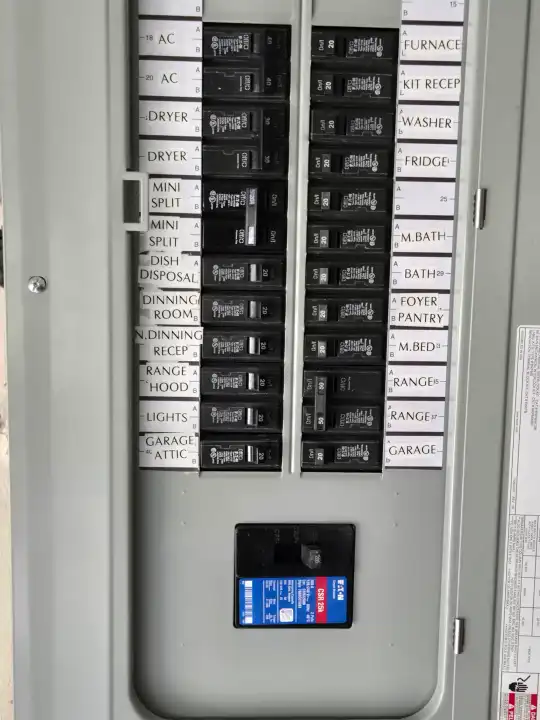
Most people shop for the charger first and think about the panel second. That order causes the surprises. A home charger is not a lamp you plug into any outlet. It draws a steady, heavy load for hours at a time, and the electrical panel in your garage or utility room has to carry that load on top of everything else your house already does.
What a home charger actually needs
A Level 2 home charger runs on its own dedicated circuit. That means a breaker in the panel that feeds only the charger, with wiring sized for the load and run to the spot where the charger mounts. It does not share a circuit with the garage lights, the chest freezer, or the outlets along the wall. Sharing would mean a breaker that trips every time the car and something else ask for power together.
The charger also runs for a long time. A car may charge for several hours overnight. Wiring and breakers that handle a short burst without trouble can run warm under a load that lasts all night, which is why the circuit gets sized to the charger and not to whatever happens to be nearby.
Location matters too. The charger has to sit close enough to where the car parks that the cord reaches without stretching, and the distance from the panel to that spot decides how much wire and labor the job involves. A panel on the garage wall behind where the car parks is a very different job from a panel on the far side of the house.
Why the panel gets checked first
Before anyone talks about the charger, an electrician looks at the panel. The first question is whether there is an open slot for a new breaker. The second, and the more important one, is whether the panel and the service coming into the house have capacity left to add a charger. A panel can have empty slots and still be close to its limit once the air conditioner, the range, the dryer and the water heater are all running at the same time.
So the electrician looks at what is already on the panel, the rating printed on the panel itself, and how your house really uses power. This is a quick part of the visit, and it tells you whether the job is a straightforward add or something bigger.
Condition counts as well. A panel that is old, crowded with doubled-up breakers, or showing signs of heat damage is a reason to slow down before piling a big new load onto it.
When the answer is a sub panel or an upgrade
If the main panel has no room or no spare capacity, there are two usual paths. One is a sub panel: a second, smaller panel fed from the main one, often mounted in the garage, which gives you new breaker slots close to where the charger and other garage loads live. The other is a panel upgrade, which replaces the main panel with one rated to carry more.
Which one fits depends on what the evaluation shows. A sub panel solves a shortage of slots and shortens the wire run, but it still draws from the same service, so it only helps if the service has capacity to give. An upgrade addresses the limit of the panel itself. Your electrician will explain which problem your house actually has, and will check what your city requires for the work, since requirements differ from town to town.
Sometimes the answer is neither. Plenty of panels have room, and the charger goes in with one new breaker and one new run of wire. Nobody should sell you a bigger panel before the numbers say you need one.
Questions to settle before you buy
- Where will the car park, and where will the charger mount on the wall?
- Does the charger you like need a particular circuit size? The manual or spec sheet says.
- Is the unit hardwired or does it plug into a dedicated outlet? Your electrician can tell you which suits the model you chose.
- What else runs at the same time, such as an electric range, a dryer or a heat pump?
- Is the panel in good shape, and does it have room?
Bringing the charger's spec sheet to the electrician helps, because the circuit gets sized to the unit you actually bought and not to a guess. Some chargers let you set a lower charging current, which can matter in a house with tight capacity, so ask about that feature if panel space is a worry.
Homes and businesses
Pro Phase Electric installs EV chargers at homes and at businesses, and the questions are the same in both places. A shop or small office with several employees who drive electric has to think about what the building's service can carry before adding chargers, because the load adds up fast with more than one. A single charger at a house is the simpler case.
If you are thinking about an EV charger and are not sure your panel can take it, call Pro Phase Electric at (479) 287-3650. We are based in Lowell and work across Bentonville, Rogers, Springdale, Fayetteville and the towns around them. A look at the panel is where the conversation starts.
Pro Phase Electric, (479) 287-3650
Call (479) 287-3650More articles
Flickering Lights, Warm Outlets and a Breaker That Keeps Tripping
These warning signs start small, and the hard part is that you cannot tell the minor ones from the serious ones by looking.
Electrical Safety Inspection Before Buying a House in Northwest Arkansas
Most of a house's wiring is behind walls and inside a metal box, which makes the electrical system one of the hardest to judge by eye.